Thou, Thee, Thy, Thine, and Ye: Meanings, Differences, and Correct Usage
When King Lear rejects his daughter Cordelia, he tells the King of France:
In this article
Thou hast her, France. Let her be thine
The words come from King Lear, Act 1, Scene 1. In modern English, Lear is saying, “You have her, France. Let her be yours.”
Three older forms appear in this short statement. Thou means “you” as the subject, hast is the corresponding form of “have,” and thine means “yours.”
Shakespeare’s pronouns follow grammatical patterns that modern English no longer uses in ordinary conversation. Understanding thou, thee, thy, thine, and ye makes it easier to read his dialogue, distinguish forms of address, and write historically inspired sentences without confusing their meanings.
Thou, Thee, Thy, Thine, and Ye at a Glance
The modern word you performs several grammatical functions. It can identify someone carrying out an action, someone receiving an action, or one person among several being addressed.
Earlier English had additional forms for these purposes.
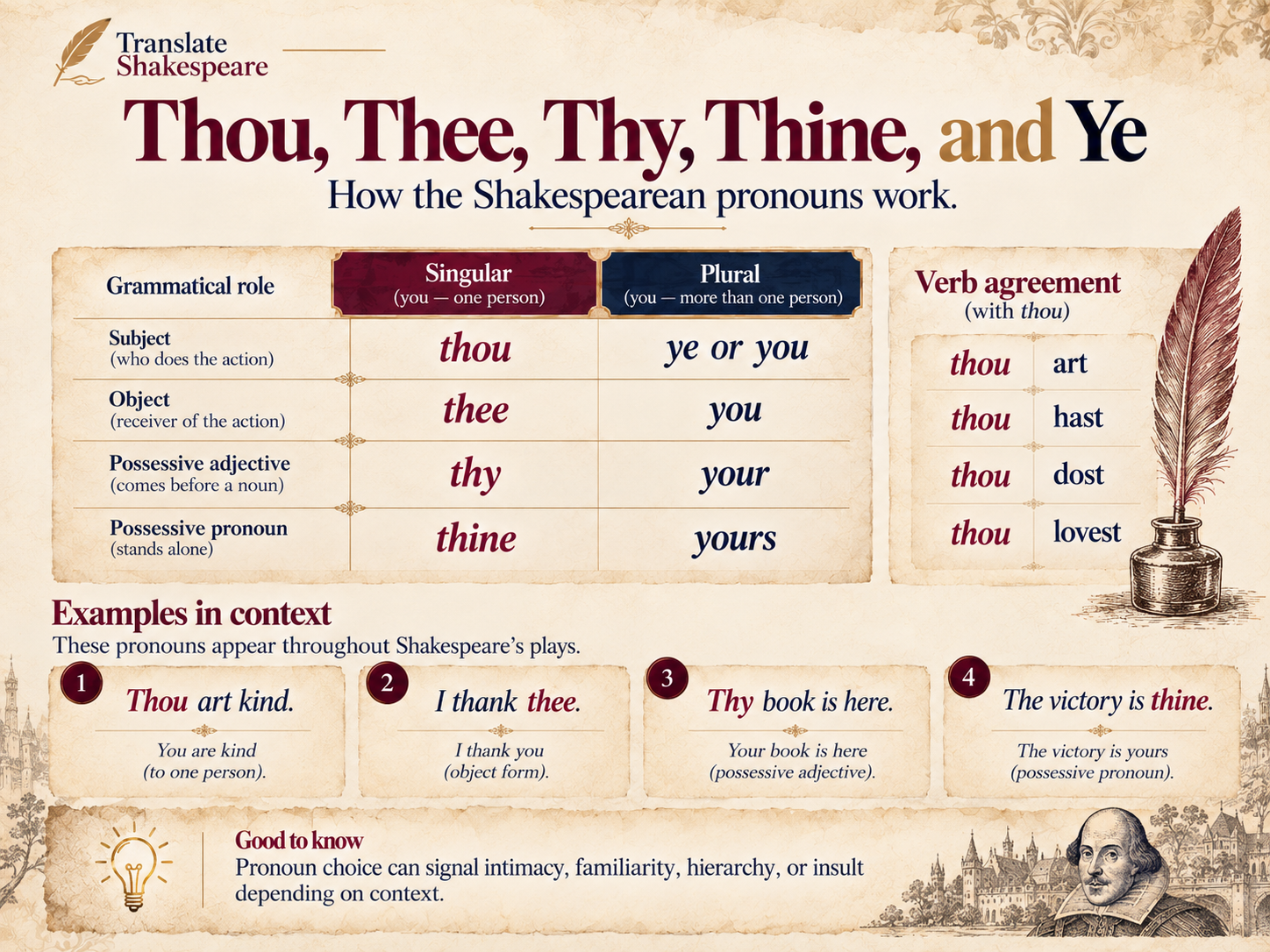
| Pronoun | Modern equivalent | Grammatical function | Example |
|---|---|---|---|
| Thou | You | Singular subject | Thou art welcome. |
| Thee | You | Singular object | I shall follow thee. |
| Thy | Your | Possessive before a noun | Thy words are kind. |
| Thine | Yours; sometimes your | Independent possessive or possessive before a noun | The choice is thine. |
| Ye | You | Historically a plural subject form; also used in respectful singular address | Ye have heard the news. |
The examples in this table are illustrative sentences, not quotations from Shakespeare.
Four of these forms belong to the singular thou system. Ye belongs historically to a different set of second-person pronouns, associated primarily with plural address.
The forms you, your, and yours also existed in Shakespeare’s period. A complete account must include them because Shakespeare used both sets.
The fundamental question is grammatical: What role does the person being addressed play in the sentence?
Once that role is identified, the choice between thou, thee, thy, and thine becomes much easier.
Thou and Thee: Subject and Object
Modern English uses you in both of these sentences:
- You understand me.
- I understand you.
The word is unchanged even though its grammatical function is different.
In the older singular system, the distinction was visible:
- Thou understandest me.
- I understand thee.
The first pronoun is the subject of the sentence. The second is its object.
When to Use Thou
Thou identifies the singular person performing an action or being described.
In King Lear, Act 1, Scene 1, Lear tells France:
Thou hast her, France.
Here, thou is the subject of hast. Lear is addressing France directly, and France is the person to whom the statement applies.
The subject form also appears in constructions such as thou art (you are), thou dost (you do), and thou knowest (you know).
The verb must agree with the pronoun. For example, “Thou are welcome” combines an older subject pronoun with the wrong form of the verb. The expected construction is “Thou art welcome.”
A subject may also appear after the verb in a question. In “Dost thou understand?” the pronoun remains the subject even though it follows dost.
When to Use Thee
Thee identifies the singular person receiving an action or serving as the object of a preposition.
Compare the illustrative sentences:
| Sentence | Function of thee |
|---|---|
| I hear thee. | Object of hear |
| She speaks to thee. | Object of the preposition to |
| I shall remember thee. | Object of remember |
| This gift is for thee. | Object of the preposition for |
A particularly useful original example appears in King Lear, Act 1, Scene 1.
When the King of France accepts Cordelia despite her father’s rejection, he declares:
Thee and thy virtues here I seize upon
Thee is the object of seize upon, even though Shakespeare places it at the beginning of the sentence.
This detail matters when reading verse or dramatic dialogue. An object does not always appear after the verb that governs it.
The position of a pronoun can change for rhetorical or poetic reasons without changing its grammatical function.
The passage can be checked in the Folger edition of King Lear, Act 1, Scene 1.
Thy and Thine: How Possession Works
Thy and thine express possession or association with the person being addressed.
They resemble modern your and yours, but Early Modern English allowed a greater range of forms before nouns.
Thy Before a Noun
The most straightforward use of thy is before a noun.
Examples include:
- Thy father — your father
- Thy name — your name
- Thy words — your words
- Thy promise — your promise
In King Lear, Act 1, Scene 1, France addresses Cordelia using the words:
Thee and thy virtues
Thy modifies the noun virtues. It identifies whose qualities France is praising.
The distinction between thee and thy is especially clear here because both appear in the same phrase.
Thee refers to Cordelia herself; thy virtues refers to qualities belonging to her.
Thine as an Independent Possessive
When possession is expressed without a following noun, thine corresponds to modern yours.
Lear’s statement:
Let her be thine
means “Let her be yours.”
Another example appears in Hamlet, Act 1, Scene 2, when King Claudius addresses Laertes:
Time be thine
Here, thine stands independently. It expresses possession without a following noun.
In ordinary modern English, the same grammatical distinction appears between your and yours:
- This is your book.
- This book is yours.
The older thy/thine system shares this distinction but includes additional historical variation.
Why Shakespeare Sometimes Uses Thine Before a Noun
Thine could also appear directly before a noun, especially one beginning with a vowel sound.
In Sonnet 132, Shakespeare writes:
Thine eyes I love, and they, as pitying me,
Here, thine functions like your before eyes.
In the same sonnet, Shakespeare uses thy heart. The contrast illustrates a traditional pattern:
| Common historical pattern | Example | Modern English |
|---|---|---|
| Thy before a consonant sound | Thy heart | Your heart |
| Thine before a vowel sound | Thine eyes | Your eyes |
| Thine without a following noun | The book is thine | The book is yours |
The first two examples are consistent with language found in Sonnet 132. The third is an illustrative sentence.
The vowel pattern was a tendency, not an absolute rule in Shakespeare’s English.
For example, in Romeo and Juliet, Act 3, Scene 5, Capulet addresses Juliet using thy eyes. In Sonnet 132, Shakespeare uses thine eyes.
Both constructions occur in his writing.
Historical research by Merja Kytö and Terry Walker, published in the International Journal of English Studies, examines how the forms my/mine and thy/thine changed during the Early Modern English period. Their findings support the importance of pronunciation, changing usage, and variation between the forms.
The research is available in A Standardization Process in its Final Stages: Mine and Thine in a Corpus of English Dialogues 1560–1760.
For someone writing Shakespeare-inspired English today, thy before consonants and thine before vowels is a useful starting convention. Original Shakespeare passages should still be read according to the forms actually present in the text.
Thine Own and Other Familiar Expressions
A well-known example occurs in Hamlet, Act 1, Scene 3, when Polonius advises his son Laertes:
This above all: to thine own self be true,
The phrase thine own self means “your own self.”
Here, thine appears before own, which begins with a vowel sound.
The wording demonstrates a possessive construction that became particularly recognizable in literary and formal English.
Read the complete speech in the Folger edition of Hamlet, Act 1, Scene 3.
Ye and You: The Older Plural Forms
Ye is different from the singular forms discussed above.
Historically, English distinguished between addressing one person and addressing several people. The older plural system also distinguished between subject and object forms.
In simplified historical terms:
| Function | Singular forms | Plural forms |
|---|---|---|
| Subject | Thou | Ye |
| Object | Thee | You |
| Possessive before a noun | Thy / Thine | Your |
| Independent possessive | Thine | Yours |
This table represents the historical distinctions underlying the system. Actual usage changed considerably over time.
Ye was originally associated with the plural subject position, but plural forms also came to be used when addressing one person respectfully.
Meanwhile, you expanded beyond its earlier object role.
The Oxford English Dictionary explains that you began replacing ye as a plural subject during the Middle English period and had become dominant in that function in most written English by the end of the sixteenth century.
It also documents how historically plural forms developed singular uses associated with respect, deference, and formality.
The dictionary’s historical entry for you explains these developments.
Why Shakespeare Often Uses You Instead of Ye
By Shakespeare’s lifetime, you was already widely used as both a subject and an object.
It could refer to one person or several people.
Shakespeare’s dialogue therefore contains many sentences in which you performs the same grammatical functions it performs today.
Modern editions can make ye even less visible because editors sometimes modernize the older form to you.
The Folger Shakespeare Library explains this editorial practice in its introduction to Richard III.
That is why a reader should be cautious about treating ye as a universal feature of Shakespearean dialogue. Its presence varies across historical texts, and its representation may also depend on the edition.
In modern English, ye survives in certain regional varieties, including forms of Irish, Scottish, and northern English speech. These uses have their own histories and should not automatically be treated as theatrical archaisms.
Is Ye in “Ye Olde” the Same Word?
No. This is a separate historical spelling issue.
In expressions such as “Ye Olde Shoppe,” the word written ye represents the, not the plural pronoun meaning you.
Older English used a letter called thorn, written þ, for the sound now represented by th.
In some historical writing and printing, a character resembling y stood in for thorn. The written form could therefore resemble ye even when the intended word was the.
Oxford’s dictionary explanation of “ye olde” describes this convention.
The expression is consequently understood as “the old,” and the historical spelling should not be read as if it were the pronoun ye.
This is a different issue from choosing the correct form of address in a Shakespearean sentence.
Pronouns and Their Matching Verb Forms
Choosing the right pronoun is only part of constructing a grammatically consistent sentence.
The verb often changes with it.
The most common patterns involving thou are:
| Modern construction | Older singular construction |
|---|---|
| You are | Thou art |
| You have | Thou hast |
| You do | Thou dost |
| You will | Thou wilt |
| You shall | Thou shalt |
| You can | Thou canst |
| You know | Thou knowest |
| You love | Thou lovest |
The forms art, hast, and dost are distinctive forms of common verbs.
Other verbs frequently take an ending such as -st or -est. The exact form depends on the verb and historical usage.
Shakespeare also used ordinary you constructions alongside these forms.
Questions, Negatives, and Commands
The pronoun retains its grammatical role when the sentence becomes a question.
For example:
- Thou dost remember. — You remember.
- Dost thou remember? — Do you remember?
- Thou dost not remember. — You do not remember.
These are illustrative grammatical examples.
The same principle applies to forms such as canst and wilt:
- Canst thou help me? — Can you help me?
- Wilt thou help me? — Will you help me?
The difference between canst and wilt can affect meaning because ability and willingness are different ideas.
Commands require separate attention. An imperative does not automatically take a -st ending simply because it addresses one person.
For example, “Hear me” is already a command. The speaker could also say “Hear thou me” in an appropriate historical construction, but adding -st to every command would be incorrect.
A detailed account of auxiliary verbs, tense, negation, and agreement belongs to Shakespearean grammar. The important point here is that pronouns and verbs form a connected grammatical system.
What Thou and You Reveal About a Relationship
The older second-person forms could communicate more than grammatical number.
By Shakespeare’s time, you was commonly used in respectful or formal address. Thou could express familiarity, intimacy, affection, authority, or contempt.
Its meaning depended on the relationship and the circumstances.
Literary scholar Lynne Magnusson examines these implications in A Modern Perspective: Shakespeare’s Sonnets, published by the Folger Shakespeare Library.
She describes how pronoun selection can reflect relationships involving social hierarchy and closeness.
One of the most revealing examples appears in King Lear.
Lear and Cordelia: Address Within a Family
In Act 1, Scene 1, Lear demands public declarations of love from his daughters before dividing his kingdom.
Cordelia refuses to exaggerate her feelings, insisting that she loves and respects her father according to her obligations.
She addresses him with you:
You have begot me, bred me, loved me.
Lear, meanwhile, uses thy when questioning her sincerity:
But goes thy heart with this?
Later, as his anger grows and he disowns Cordelia, he addresses her with thou.
The difference fits historical patterns in which a daughter might address her royal father respectfully while a father could use familiar singular forms toward his child.
However, the dialogue does not establish one fixed emotional value for every pronoun. Lear himself also uses you toward Cordelia earlier in the scene.
The relationship, shifts in feeling, and social setting all matter.
It would therefore be misleading to interpret each appearance of thou as affectionate or each appearance of you as emotionally distant.
A Pronoun Can Change the Force of an Insult
Elsewhere in Shakespeare, forms of address can contribute to confrontation.
A speaker who expects respectful treatment may experience an unexpected thou as an insult or expression of contempt.
Such language can emphasize a claim to superiority or deliberately challenge another person’s dignity.
The effect depends on the exchange. A form used warmly between friends can become hostile in a conflict.
The choice is part of the dramatic relationship, not a separate label identifying the speaker’s emotion.
How to Choose the Correct Form in Your Own Sentences
When writing historically inspired English, begin with the grammatical meaning of the modern sentence.
Modern you leaves several questions unanswered: whether the person is the subject or object, whether one person or a group is addressed, and what kind of social relationship the speaker intends.
These details influence the older form.
A Practical Selection Method
- Identify who is addressed. Is the sentence directed toward one person or several?
- Find the grammatical function. Is the person the subject, object, or possessor?
- Select the appropriate form. For a familiar singular address, choose thou, thee, thy, or thine according to that function.
- Check the verb. A subject such as thou may require art, hast, dost, or another suitable agreement.
- Consider the relationship. A respectful singular you may be more fitting than thou, even when only one person is addressed.
The distinction can be seen in three versions of a simple sentence:
| Sentence | Interpretation |
|---|---|
| You are welcome. | Ordinary modern English; also compatible with historical respectful address |
| Thou art welcome. | Singular address using the thou system |
| Ye are welcome. | Historical-style plural address, with ye as the subject |
These are composed examples for comparison, not Shakespeare quotations.
A modern sentence does not always contain enough information to determine which historical form a particular speaker would choose.
A Worked Example
Suppose the modern sentence is:
“You have my letter, and I will remember you.”
If the speaker is addressing one person using the familiar thou system, a possible adaptation is:
Thou hast my letter, and I shall remember thee.
The first you is the subject, so it becomes thou, accompanied by hast.
The second you is the object of remember, so it becomes thee.
The possessive my remains unchanged because it refers to the speaker, not the person being addressed.
This subject-and-object distinction is useful when experimenting with Shakespearean-style translations of your own sentences. Two appearances of modern you may require different historical forms even within one sentence.
Now compare:
“I have your letter.”
A corresponding adaptation would be:
I have thy letter.
Here, your indicates possession before a noun, so thy is appropriate.
The same selection method applies across longer passages: determine what each pronoun refers to and how it functions before choosing the historical form.

Written by Julian Ashworth
Reviewed by the TranslateShakespeare.com editorial team.