
How to Write Like Shakespeare: Style, Dialogue, and Examples
A character discovers that a trusted friend has betrayed a secret. The simplest response is, “I can no longer trust you.” But what if the speaker desperately wants an apology? What if the betrayal has become public knowledge? What if the speaker intends to forgive the friend while pretending otherwise?
In this article
Each situation calls for different words.
Writing like Shakespeare begins with understanding what language must accomplish. His characters use imagery, contrast, rhythm, humor, and persuasive arguments to express desires that are often complicated by fear, pride, love, or ambition.
You can borrow these techniques to create Shakespeare-inspired dialogue, speeches, letters, and other forms of expressive writing. Historical vocabulary can contribute to the effect, but the most convincing results come from giving ordinary thoughts a distinctive dramatic voice.
Give the Speaker a Reason to Speak
Before writing a line, establish the situation that produces it.
A character’s words usually have an immediate purpose. Someone may be attempting to win affection, conceal a mistake, challenge an authority figure, or persuade another person to make a dangerous decision.
The purpose influences both the content and the manner of expression.
Imagine a character who suspects a friend of dishonesty.
One possible line is:
Your silence is answer enough.
This speaker treats the absence of an explanation as evidence of guilt. The statement closes down the conversation.
Another version might be:
Speak once in truth, and I shall yet believe you.
Here, the speaker leaves room for reconciliation. The accusation is still present, but the immediate objective is to obtain an explanation.
Both lines are newly composed examples. Neither depends on elaborate historical vocabulary. Their differences arise from the speaker’s intention.
Three decisions are especially useful before drafting a scene:
- What does the speaker want? An admission, a promise, forgiveness, obedience, or a change of mind?
- What prevents the speaker from getting it? Another person’s resistance, a social obligation, fear, or the speaker’s own uncertainty?
- What is at stake? A relationship, reputation, safety, freedom, or something less consequential?
A speech becomes more interesting when its words are shaped by resistance. A declaration of love made in safety is different from one that risks discovery or rejection.
Shakespeare repeatedly places powerful feelings within circumstances that make their expression difficult.
Make Abstract Feelings Visible
One of Shakespeare’s most recognizable techniques is his use of concrete images to express experiences that cannot be seen or touched.
Instead of describing an emotion only by naming it, a character may associate it with something physical: a wound, flame, storm, disease, journey, or weight.
The image gives the audience something to imagine.
Choose an Image That Belongs to the Situation
In Romeo and Juliet, Act 2, Scene 2, Romeo sees Juliet at her window and declares:
It is the East, and Juliet is the sun.
He transforms Juliet into the source of light that governs his imagined world. The image conveys admiration and gives his feelings an expansive, almost cosmic quality.
The Folger edition of the scene shows how Romeo extends this image through references to the moon and the sky.
A writer can apply the same principle without copying Romeo’s imagery.
Suppose the modern sentence is:
“Your kindness helped me through a difficult time.”
An original, more expressive version could be:
Your kindness was a candle in those darkened days.
The candle suggests comfort and guidance, while the surrounding darkness represents hardship.
That is one possible treatment, not a universally better sentence. For a speaker accustomed to practical work, a different image may feel more natural. A sailor might speak of a guiding light, while a farmer might draw upon weather or the changing seasons.
The source of an image should make sense for the person using it.
Let the Image Expose the Character
Shakespeare’s metaphors often reveal how a speaker understands a personal problem.
In Macbeth, Act 1, Scene 7, Macbeth describes his motivation for murdering Duncan through the image of a rider and a horse. The phrase “vaulting ambition” presents ambition as something capable of leaping beyond its proper limits.
Macbeth’s image suggests both his desire for power and the danger that desire creates.
The Folger editors examine the metaphor in their guide to the language of Macbeth.
A useful writing principle emerges: choose an image that reveals the speaker’s attitude toward the subject.
Two people can describe the same event very differently. One might imagine an approaching decision as a doorway to freedom; another might see it as the edge of a cliff.
Their vocabulary tells the reader something about their personalities.
Avoid crowding one sentence with unrelated comparisons. A consistent image usually gives the reader more to follow than several striking images competing for attention.
Build Arguments Through Contrast and Repetition
Shakespeare’s language frequently follows the movement of a character’s thinking.
A speaker may compare opposing choices, repeat a claim, question an assumption, or return to a familiar phrase after its meaning has changed.
These techniques give dramatic writing structure.
Antithesis: Put Opposing Ideas Into Conflict
Antithesis places contrasting ideas within a closely connected expression.
The contrast may concern love and hatred, loyalty and betrayal, appearance and reality, or two possible courses of action.
In Othello, Act 1, Scene 1, Iago describes his deceptive conduct with the declaration:
I am not what I am.
The contradiction captures his intention to conceal his motives behind an appearance of loyalty.
Read in context, the statement also prepares the audience to recognize the difference between what Iago says publicly and what he intends privately.
The original wording appears in the Folger edition of Othello, Act 1, Scene 1.
Contrast can also strengthen newly composed dialogue.
A modern statement such as “I hoped you would help me, but you betrayed me” might become:
I sought a friend and found an enemy.
The opposing nouns sharpen the change in the relationship. The speaker’s disappointment is expressed through the contrast itself.
Use this technique when the conflict genuinely involves opposing ideas. Adding opposites to a sentence that has no underlying tension may make the wording sound artificially grand.
Repetition: Make Familiar Words Change Their Meaning
Repetition can reinforce an argument, but it can also expose irony.
In Julius Caesar, Act 3, Scene 2, Mark Antony repeatedly refers to Brutus as an “honorable man” while presenting evidence that challenges the audience’s trust in Caesar’s assassins.
Initially, the description resembles respectful acknowledgment. As Antony continues, its effect becomes increasingly ironic.
The audience hears familiar words in a changing argumentative context.
The Folger text of Antony’s funeral speech shows how his argument develops through repetition and carefully controlled appeals.
For your own writing, repetition should have a purpose.
A character might repeat “You promised” while confronting someone who has broken a commitment. But repeating the same accusation several times without changing its meaning will simply lengthen the speech.
The more effective approach is to let the surrounding evidence alter how the repeated words are understood.
Rhetorical Questions: Challenge Without Asking for Information
A rhetorical question can accuse, persuade, or reveal uncertainty without requiring a literal answer.
For example:
Direct statement: “You have forgotten your promise.”
More confrontational version: “Was your promise made only to be forgotten?”
The question challenges the listener’s integrity. The speaker already believes the promise has been broken.
A question can also express genuine inner conflict. A character who asks whether loyalty is worth the cost may be struggling with a decision rather than confronting another person.
Choose the form according to the speaker’s intention. A succession of dramatic questions becomes tiring when none changes the direction of the thought.
Give Each Character a Distinct Voice
Shakespeare’s characters do not all speak with the same degree of formality or emotional intensity.
Their language changes according to personality, relationship, and circumstance. The contrast between different voices helps an audience understand a scene.
In the balcony scene of Romeo and Juliet, Romeo imagines Juliet in terms of the sun and celestial light. Juliet, meanwhile, recognizes the immediate danger of his presence in the Capulet household.
She warns him:
If they do see thee, they will murder thee.
Romeo’s imaginative expression and Juliet’s practical warning belong to the same conversation, but they approach the situation differently.
Juliet loves Romeo, yet she is also alert to the consequences of his discovery.
This variation offers a valuable lesson for dialogue writing: two characters can share an emotion without describing it in the same manner.
A fearful person may speak in short, urgent sentences. Someone trying to appear confident might use formal declarations. Another character may conceal discomfort behind jokes or deliberate understatement.
Match the Language to the Relationship
A private conversation between close companions may allow familiar speech that would be inappropriate in a public address.
A character seeking forgiveness may use softer language than someone issuing a command. A person claiming authority may prefer language that sounds decisive and controlled.
Social position matters, but it should not determine every sentence. Shakespeare often complicates expectations by giving quick wit to socially subordinate characters or moments of plain, direct speech to powerful figures.
For creative writing, establish a consistent voice first. Allow it to change when the character’s circumstances give that change a reason.
Allow Plain Speech Beside Elaborate Speech
Not every line needs a metaphor.
A short, direct answer can be powerful after a long declaration. A sudden command may interrupt a carefully constructed argument, revealing an emotion the speaker can no longer conceal.
A character who speaks poetically during a private confession might become unusually blunt when threatened.
Varying the density of the language prevents the entire scene from sounding like one continuous formal speech.
Use Historical Language With Care
Shakespeare-inspired writing can include expressions such as hath, prithee, ere, or thou, but they should be chosen for their meaning and grammatical function.
The vocabulary of Early Modern English was broad, and Shakespeare used forms that remain ordinary today alongside those that now sound archaic.
Our Shakespearean words and meanings reference helps distinguish unfamiliar expressions from familiar words with older senses. When a sentence addresses someone directly, the differences between thou, thee, thy, and thine also become relevant.
A historical word should not be inserted simply because it sounds old.
For instance, hath belongs to a different grammatical construction from thou hast. Combining forms without regard to agreement can undermine the result.
The larger patterns of verb use, questions, and sentence construction are covered in Shakespearean grammar.
When writing creatively, there is no requirement to place an archaic word in every sentence. A passage with clear imagery and effective dramatic contrast may achieve a recognizable Shakespeare-inspired style using almost entirely familiar English.
Write for the Ear: Rhythm, Pauses, and Delivery
Shakespeare wrote plays intended to be performed. The experience of hearing the words influences how audiences understand them.
Some of his dramatic dialogue is in prose, while much of his verse uses blank verse, commonly associated with iambic pentameter.
The Royal Shakespeare Company’s language resources for Romeo and Juliet explain how prose, verse, and rhythmic variation contribute to dramatic expression.
You do not need to master formal meter before attempting Shakespeare-inspired dialogue. Begin by listening to the rhythm of an ordinary sentence.
Read the line aloud and notice:
- Which words naturally receive emphasis?
- Does the sentence give the speaker enough room to pause?
- Is an important idea buried beneath unnecessary description?
- Would an actor understand what the character wants to communicate?
A sentence that looks impressive on the page may sound cumbersome when spoken.
Conversely, a short line can acquire considerable force when placed after silence, hesitation, or a longer speech.
Rhyme can create emphasis or a sense of closure, but forcing every line to rhyme may distract from the conversation. Shakespeare’s dramatic writing frequently uses unrhymed verse and ordinary prose.
Treat sound as part of the character’s expression, allowing the natural stresses of the words to support the intended meaning.
A Complete Example: Turning Modern Dialogue Into Shakespeare-Inspired Speech
The following scene demonstrates how several writing choices can work together.
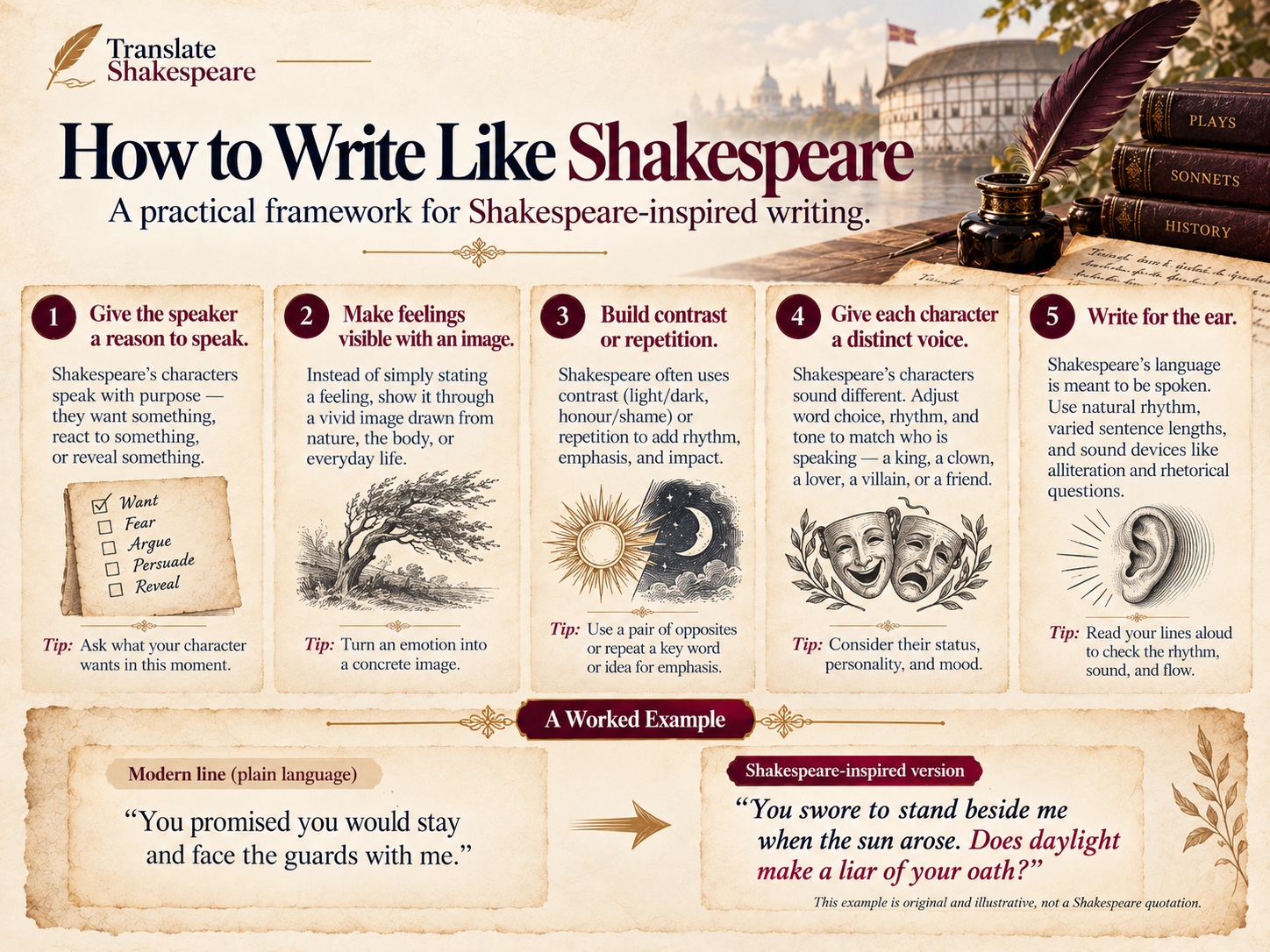
Two people, Mara and Elias, have agreed to stand together when guards arrive at sunrise. Elias now intends to leave, fearing arrest.
Mara wants him to remain. Elias wants to escape without admitting that fear has overcome his promise.
The Original Modern Exchange
Mara: You promised you would stay and face the guards with me.
Elias: If I stay, they will arrest me.
Mara: So you’re breaking your promise?
This dialogue establishes the essential conflict. Both characters have understandable motives, but the exchange leaves considerable room for expressive development.
The Shakespeare-Inspired Version
\
Mara:\ You swore to stand beside me when the sun arose.\ Does daylight make a liar of your oath?
Elias:\ If I remain, the watch will seize me at the gate.
Mara:\ Then go. I will not hold a man\ Whose promise cannot hold him.
The scene now gives the speakers more distinctive voices while preserving their disagreement.
Why These Changes Work
1. The time of day becomes part of the accusation.
In the modern version, sunrise is merely the agreed time.
Mara now connects daylight with the breaking of an oath. The arrival of morning becomes the moment that exposes Elias’s intentions.
The image belongs naturally to the situation because their confrontation is happening at the time they had agreed to face danger together.
2. The question has an argumentative purpose.
“Does daylight make a liar of your oath?” is a challenge.
Mara does not need Elias to explain what daylight does. She is accusing him of making a promise that he cannot keep.
The question gives her anger a more dramatic form while retaining a clear meaning.
3. Elias remains comparatively direct.
His reply contains no extended metaphor.
He identifies the danger: the watch may seize him at the gate.
The plainness matters because Elias is concerned with immediate consequences, while Mara is concerned with loyalty and betrayal.
Making both characters equally elaborate would weaken the contrast between their attitudes.
4. The closing line develops a double use of hold.
Mara first uses hold to mean restrain or prevent someone from leaving.
She then applies the word to the ability of a promise to bind someone to a commitment.
Her final line communicates wounded pride. She refuses to keep Elias by force and questions the value of a promise that cannot influence his actions.
The repeated word connects her immediate decision with the underlying moral conflict.
What Was Deliberately Left Out
The revised scene does not require thee, thou, or hath to establish its style.
Its effect comes from the oath, daylight imagery, rhetorical question, contrast between speakers, and repeated verb.
It also avoids adding rhymes that might force the characters into unnatural phrasing.
If the purpose were to evoke a more historically specific voice, the writer could adjust selected expressions and grammatical forms in a later draft. The characters’ intentions should remain understandable throughout.
A first stylistic experiment can also begin by entering the modern dialogue into the English-to-Shakespearean writing tool, then comparing the resulting expression with the characters’ intended motives.
Adapt the Style to the Kind of Writing
A dramatic exchange and a personal message have different requirements.
A short greeting may need only a graceful phrase. A theatrical monologue may justify sustained imagery, argument, and changes in emotional direction.
For a personal letter, the recipient should understand the message without having to decipher every expression.
For fictional dialogue, the language can reveal character and develop conflict. A longer scene benefits from variation: moments of heightened speech can be followed by ordinary statements, interruptions, or silence.
A school creative-writing assignment may call for recognizable Shakespearean techniques, but those techniques should be used with an understanding of their function.
The goal is to adapt the expressive possibilities of the style to the intended audience.
A modern writer can draw inspiration from Shakespeare’s use of language while still producing work that is recognizably their own.
Common Mistakes in Shakespeare-Inspired Writing
Several habits can weaken an otherwise promising passage.
Adding archaic words indiscriminately. A sentence crowded with unrelated historical expressions may become difficult to understand without gaining a distinctive voice.
Reversing word order unnecessarily. Unusual syntax can create emphasis, but rearranging every sentence often makes the writing awkward. Keep the normal order when it serves the speaker better.
Using unrelated metaphors. A speech that describes one emotion as fire, a storm, a mountain, and a prison within a few lines may lose its central idea. Develop the strongest image rather than multiplying comparisons.
Giving every character the same voice. A frightened servant, confident ruler, and grieving parent may all use expressive language, but their circumstances should shape how they speak.
Forcing rhyme or rhythm at the expense of meaning. If a word has been chosen only to satisfy the end of a line, check whether the resulting sentence still says what the character intends.
Making every emotion explicit. Characters need not announce that they are angry, jealous, or afraid. Their arguments, hesitations, and attempts to influence others can reveal those feelings through action.
An effective revision often involves removing words. Ask which expressions reveal character or advance the exchange, and which merely make the sentence sound old-fashioned.
A Writing Exercise: One Sentence, Two Characters
Try working with this ordinary statement:
I know you’re leaving.
Imagine two speakers who say these words in different circumstances.
Speaker A wants the other person to stay. The departure feels like abandonment, but the speaker is too proud to beg.
Speaker B wants the other person gone. The statement is a challenge, and the speaker intends to make the departure final.
Write three or four lines for each speaker.
For the first version, an image of distance, separation, or an approaching journey might convey reluctance.
For the second, language associated with release, judgment, or the closing of a door might suit the speaker’s intention.
Give each character one purposeful contrast or question. Keep the words understandable, and allow at least one line to be plain and direct.
When you read the two speeches aloud, they should sound different even if neither contains an obviously archaic word.
The test is whether a listener can recognize the speaker’s attitude from the language itself, without being told which character wants the departure and which one fears it.

Written by Julian Ashworth
Reviewed by the TranslateShakespeare.com editorial team.


